7 Techniques for Overcoming Social Phobia
Self-treatment tips you can use today for social anxiety disorder
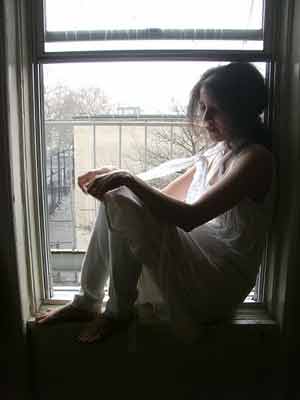 "7 Techniques for Overcoming Social Phobia" courtesy of reconstructionist
Meeting me was a sickening nightmare. Sue had been dreading it (she cheerfully admitted later).
More than just shyness, social phobia causes panic. Even just thinking about meeting or mingling with others can cause a pounding heart, dry mouth, shaky voice, rapid breathing, sweating, blushing, an upset stomach – no wonder it sometimes feels easier to avoid other people all together.
For Sue, even seeing family, friends, and colleagues – people she'd met many times before – felt like an ordeal drummed up by the Spanish Inquisition. Actually it was curious:
"I'm okay in a work context or when things are a bit more formal and organized, because I know what to talk about. But as soon as it's kind of unregulated – you know, just mixing with other people – I go to pieces. It's like I need a well-defined focus or I panic!"
Social anxiety spoils life. It gets in the way of what should be fun opportunities to meet and connect with others. Crippling self-consciousness, nervousness, or not knowing what to say: all add to the disagreeable mix.
Yes, most people sometimes get a little self-conscious or feel somewhat shy around others, but social phobia significantly worsens the quality of life. Once you become more socially confident, you open the door to so much – new job opportunities, new friendships, and, basically, more fun.
So how do I get rid of social phobia?
Learning to relax in social situations is the key (no surprise there!). Once you feel calmer socially, then thoughts like: "What do I say next?" disappear because you go into flow and allow conversation to take its own natural path, without feeling you have to force it.
And that horrible feeling of 'all eyes suddenly on me' fades as it starts to feel much less important if others are focusing on you or not.
I worked with Sue for seven weeks. At the end of that time, she invited me to a party with her husband. We had a real laugh and I could tell she was having a relaxed, fun time with many people she'd never even met before (and without too much booze J).
These seven social confidence tips will help you feel more relaxed when out with others and allow you to begin your journey from social anxious to the confident person you really can be.
1) Prepare to relax
Few people think of worrying as self-programming, but it is. Intense worry about upcoming social situations repeatedly links anxiety to the events. No wonder when you actually go into the social situation itself you feel anxious – you've programmed yourself to feel this way.
You can start to reverse this trend by taking time to think about the future gathering whilst relaxed – maybe in a warm bath or in a comfortable chair. Imagine seeing yourself looking relaxed and confident. Do this repeatedly so that your body and mind forge a new and better automatic association to these times.
2) Seek out social situations
Imagine if you lived in a house for thirty years but always avoided one room. If, after all that time, you actually ventured into the mysterious room, you might feel a little tense and anxious. Why? Because the more we avoid something, the more we send the message to the unconscious mind that: "This is dangerous, that is why I am avoiding it."
So your mind, trying to be helpful, builds up the fear (of what it is you're avoiding) even more. In nature, we avoid a clump of trees because it has lions in it or we avoid cliff edges because falling off means death.
We avoid what frightens us and are frightened by what we avoid. So start to actively put yourself in social situations. In fact, even doing this in your mind as well as for real will help show your unconscious mind that "this is normal". (See Tip 1)
3) Look at your surroundings
Socially anxious people focus inwards, on their feelings. Studies have found that people who rate themselves as shy or anxious in social settings have much worse recall for external details of the environment because they've been looking inward, not outward. So, it makes sense to focus outward more to lower anxiety. When in social situations, make a mental note of three aspects of the situation you're in. For example:
- The colour of the walls
- Any pictures on the walls and what they contain
- What other people are wearing (I must confess I never recall that!)
This may seem strange, but it will get you used to focusing away from yourself – which is, after all, what social situations are for. This neatly ties into your next tip:
4) Ask questions
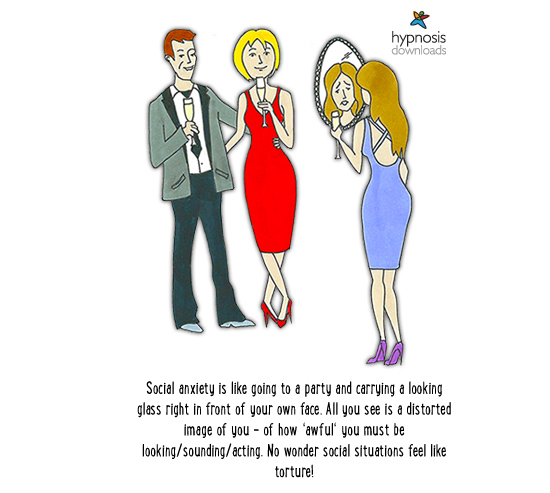
Social phobia has us worrying what other people think of us, so instead focus on other people. Cultivate curiosity. Ask people open questions which require more than just a "yes" or "no" answer. Make a point of remembering what they tell you and referring back to it later to demonstrate you were interested enough to take it in. Again, this forces your focus of attention from inward to outward. It's also nice for other people, which means you might accidentally make more friends as a 'by-product' of this strategy. Now, overcoming social phobia is as much about stopping doing stuff as it is about doing new things, so...
5) Switch off your imagination
Your imagination is a wonderful thing in its place. And if you use it constructively, it can be of massive help (see Tip 1 above). But using it to scare yourself is like using a hammer (a potentially useful tool) to wash the dishes.
Trying to imagine what people are thinking of you is a big no-no. Years of public speaking taught me to stop trying to gauge what others think of me. So if you catch yourself 'mind-reading', then tell yourself: "Look, I really don't know what these other people are thinking right now!", because that's the truth of it. Ultimately we can influence what others think of us, but we can't control it. And as you become more socially confident, you'll care less anyway.
6) What do you want?
Your mind needs positive instructions. Rather than: "I hope I don't feel terrified as usual" (which is like someone asking you directions by telling you where they don't want to end up), ask yourself: "How do I want to feel in these situations?" And get into the habit of focusing on that.
Give yourself a 'target feeling' by looking at times when you are comfortable with others (often old friends or trusted family members). Then you can prepare your mind to perform the way you want in social situations by using these situations as a template.
To do this, close your eyes and get yourself nice and relaxed. Take some time to remember how it feels to be with these familiar people until you get a strong feeling of comfort. Then imagine seeing yourself in a formerly less comfortable social situation, but behaving like you do with your trusted friends. This sort of mental rehearsal is extremely powerful and over time can make a massive difference.
7) On being yourself
Part of social phobia treatment involves teaching people to be relaxed enough to be able to present a less than perfect image. That's right; people who are relaxed about and prepared to sometimes make a 'bit of a fool of themselves' tend to be much more socially confident. Not that you need to become a party buffoon, but being prepared to show a less than perfect side to yourself is a sign of great confidence. For example, being humorous is a (slight) risk because it might just produce a stony silence (it's happened to me - no really, it has!).
The point is that social phobia gets us caring too much about what others think. Trying to present a perfect front drives out spontaneity, making us stilted.
Typical self-conscious thoughts are:
- "I hope no one notices I'm tense."
- "What if I say the wrong thing?"
- "What if people think I'm stupid?!"
- "Who would want to hear what I have to say?"
- "I think I'm coming across as a weirdo!"
These all imply that occasional tenseness, even weirdness and inappropriate speech, are somehow out of the norm for human interaction. But believe me, they are not (even, I'm sure, inside Buckingham Palace!).
Worrying about ever 'putting a foot wrong' is a form of perfectionism. Being a perfectionist is fine if you are doing surgery, but not if you are meeting the in-laws or going to that party down the street.
It's not that socially confident people never act a little weird or get the wrong end of a conversation or feel flustered occasionally. It's that they relax with these things when they do happen; which they will sometimes. I liken overcoming social phobia to rubbing the rust off a valuable ornament. It takes a little while, but soon the real beauty is evident and things become what they were supposed to be all along.
10 Steps to Overcome Social Anxiety course
If just the thought of small talk makes you nervous, and social situations make you feel ill, then read on to find out how you can become socially confident and relaxed...

Get a free hypnosis session with our new Social Anxiety app for iOS & Android:
Includes our most popular social anxiety session free, with the option to upgrade to 10 more sessions.
Get the Social Anxiety app for iOS (iPhone or iPad) here or for Android here.