6 Key Social Skills
 "Party Animal" courtesy of prettyinprint
Social skills are arguably the most important set of abilities we can have. Having great social skills help you meet interesting people, get that job you want, progress further in your career and relationships. Some people are just naturally blessed with good social skills and easy smooth conversation, aren't they?
Lack of good social skills can make life lonely, causing anxiety and depression. We get depressed and anxious when we don’t meet our fundamental human needs. And the need to socialize, to connect with others is fundamental. We all need social contact. But it’s a trap to assume that you either have social skills or you don’t.
Sure, some people find it easier to naturally relax around people, talk and listen confidently. But like any set of skills, social skills can be learned, honed and developed by anyone. And social skills training are a vital part of building confidence.
But what are social skills? I’ve made a list here of some of the most important:
1) The ability to stay calm in social situations
Regardless of how many social skills you have; if you’re anxious then your brain won’t work properly. It’s always harder to think and speak clearly when we become agitated. So calming down is vital. But relaxing in social situations helps in another way too.
If your body and face give the unconscious message that you’re nervous, it will be more difficult for others to relax with you making harder for you to build rapport with them. This article on how to control your emotions may help you.
People make a huge mistake though when they assume that gaining good social skills is just about starting to speak well. Take a look at the next skill:
2) Listening skills: The art of connection
When you had dinner with Gladstone, you were left feeling that he was the most charming person you had ever met. But after dinner with Disraeli, you felt that you were the wittiest, the most intelligent, the most charming person.
Dr Warren Bennis PhD, University of California
There is little more attractive and seductive than being truly listened to. Good listening skills include:
- Making 'I'm listening' noises - 'Uh-huh', 'really?', 'oh yes?' etc.
- Feeding back what you've heard - "So he went to the dentist? What happened?"
- Referring back to others' comments later on - "You know how you were saying earlier…"
- Physical stillness, eye contact and attentiveness while the other person is talking.
- To listen well to others you need to develop real interest in them.
3) Empathy with and interest in others' situations
A major part of social anxiety is self consciousness, which is greatly alleviated by focusing strongly on someone else. A fascination (even if forced at first) with another's conversation not only increases your comfort levels, it makes them feel interesting. I never worry what I’m going to talk about because I know I can get other people to talk.
The best social situations are the ones in which you actually forget about yourself and become focused on what is going on and other people. A major social skill is being able to focus outward.
4) Knowing how to build rapport
Rapport is a state of understanding or connection that occurs in a good social interaction. It says basically "I am like you, we understand each other". Rapport occurs on an unconscious level, and when it happens between two people you can see it because, the language, speech patterns, body movement and posture of the two people seem to mirror and match.
Rapport is an unconscious process, but it can be increased as part of social skills training. Practice the following:
- Body posture 'mirroring', or movement 'matching'. When you are within someone match their body posture and expressions. Don’t mimic too closely this is supposed to have an unconscious effect
- Reflecting back language and speech, including rate, volume, tone, and words
- Feeding back what you have heard
- Think about building rapport and you’ll feel naturally more socially confident as you’ll be focusing outward.
5) Knowing how, when and how much to talk about yourself - 'self disclosure'
Talking about yourself too much and too early can be a major turn-off for the other party in conversation. Good initial small-talk is often characterized by discussion of subjects not personal to either party, or by an exchanging of personal views in a balanced way. Immediately describing your deepest desires and darkest fears to a stranger may freak them out.
However, as conversations and relationships progress, disclosing personal facts (small, non-emotional ones first!) leads to a feeling of getting to know each other. Now lets look at the importance of how your eyes communicate.
6) Look into their eyes and smile
If you don't look at someone when you are talking or listening to them, they’ll feel:
- You are ignoring them
- You are untrustworthy
- You don't like the look of them (!)
This doesn't mean you have to stare at them. Too much eye contact too early on in a relationship can be unsettling too.
Research on attractiveness has shown (not surprisingly) that smiling whilst looking directly at someone makes you appear much more attractive (1)
Having great social skills will enhance your life. Speaking clearly and gaining the confidence to speak in front of people (see also public speaking techniques) will mean that talking to new people and relaxing with friends old and new will be a breeze.
Don’t lament not being naturally confident or socially able; rather, instead, seek to enhance your social skills for a better life.
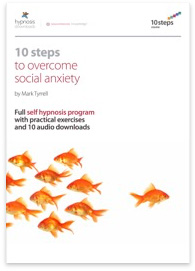
10 Steps to Overcome Social Anxiety course
If just the thought of small talk makes you nervous, and social situations make you feel ill, then read on to find out how you can become socially confident and relaxed...
References
- Claire Conway and colleagues at the University of Aberdeen in Scotland found that both men and women deemed faces looking straight at them to be more attractive and more likeable, even if the faces looked disgusted. Though unsurprisingly, there was a greater preference for smiles.